Strong multiphysics coupling
Mass, momentum, energy, species and additional transport equations are assembled and advanced in a unified implicit framework.

NeuralFlow multiphysics CFD
NeuralFlow is LIKUA's fully implicit finite-volume solver for compressible, thermal, reacting and particle-laden flows. It is developed around accuracy, validation evidence and robust convergence for difficult engineering problems, while its modular numerical architecture supports rapid customization of physical models, boundary conditions, source terms and analysis workflows.
What makes NeuralFlow different
NeuralFlow is designed around equation-level coupling. Turbulence, species, combustion, dispersed phases, thermal solids and other source-driven models can participate directly in the implicit solution rather than being treated only through weak sequential updates.
Mass, momentum, energy, species and additional transport equations are assembled and advanced in a unified implicit framework.
Pressure waves, shocks, recirculation, high heat release, strong source terms and particle interactions are handled with methods developed for demanding propulsion flows.
Continuity acceleration, near-wall solution acceleration, multigrid and flexible linear solvers target practical convergence on difficult meshes and operating conditions.
Core flow and time integration
The same core architecture supports steady and transient simulations from incompressible and low-Mach internal flow to shock-dominated high-speed aerodynamics.
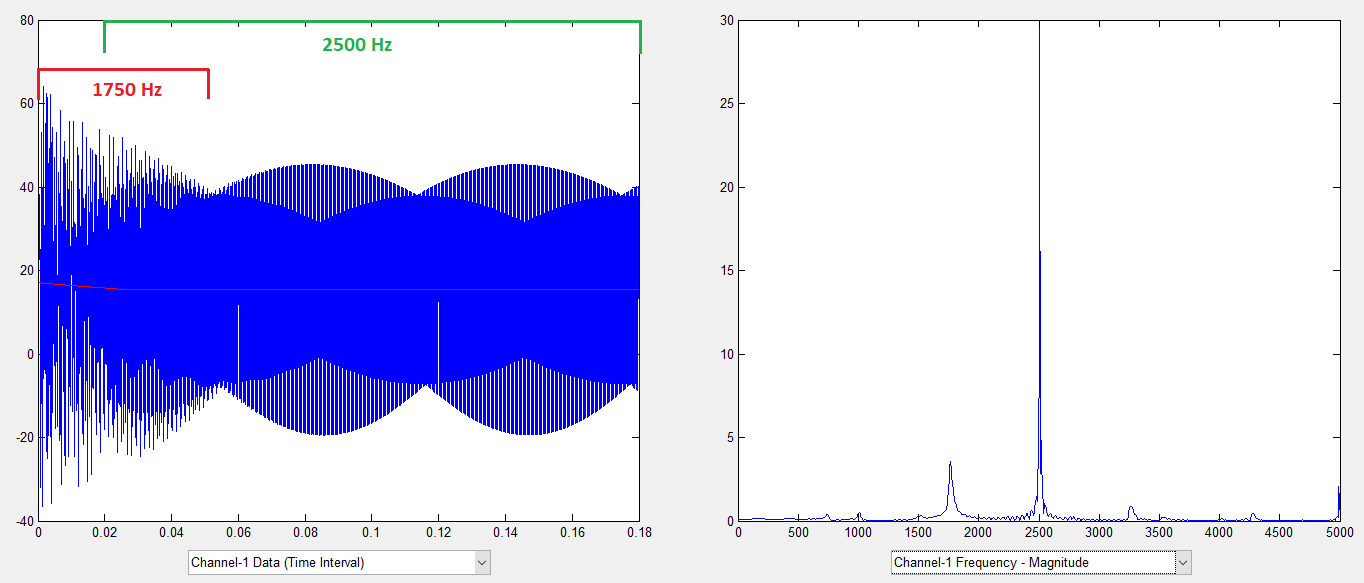
The fully implicit transient formulation advances resolved vortical structures while preserving time-accurate pressure histories for frequency-domain analysis. The paired views show temporal and spectral evidence from the same workflow.
GERANS turbulence and aerothermal modelling
NeuralFlow uses the GERANS turbulence framework, including its Realizable SST-kω formulation and scale-resolving extensions, for complex separated and compressible turbulent flows.
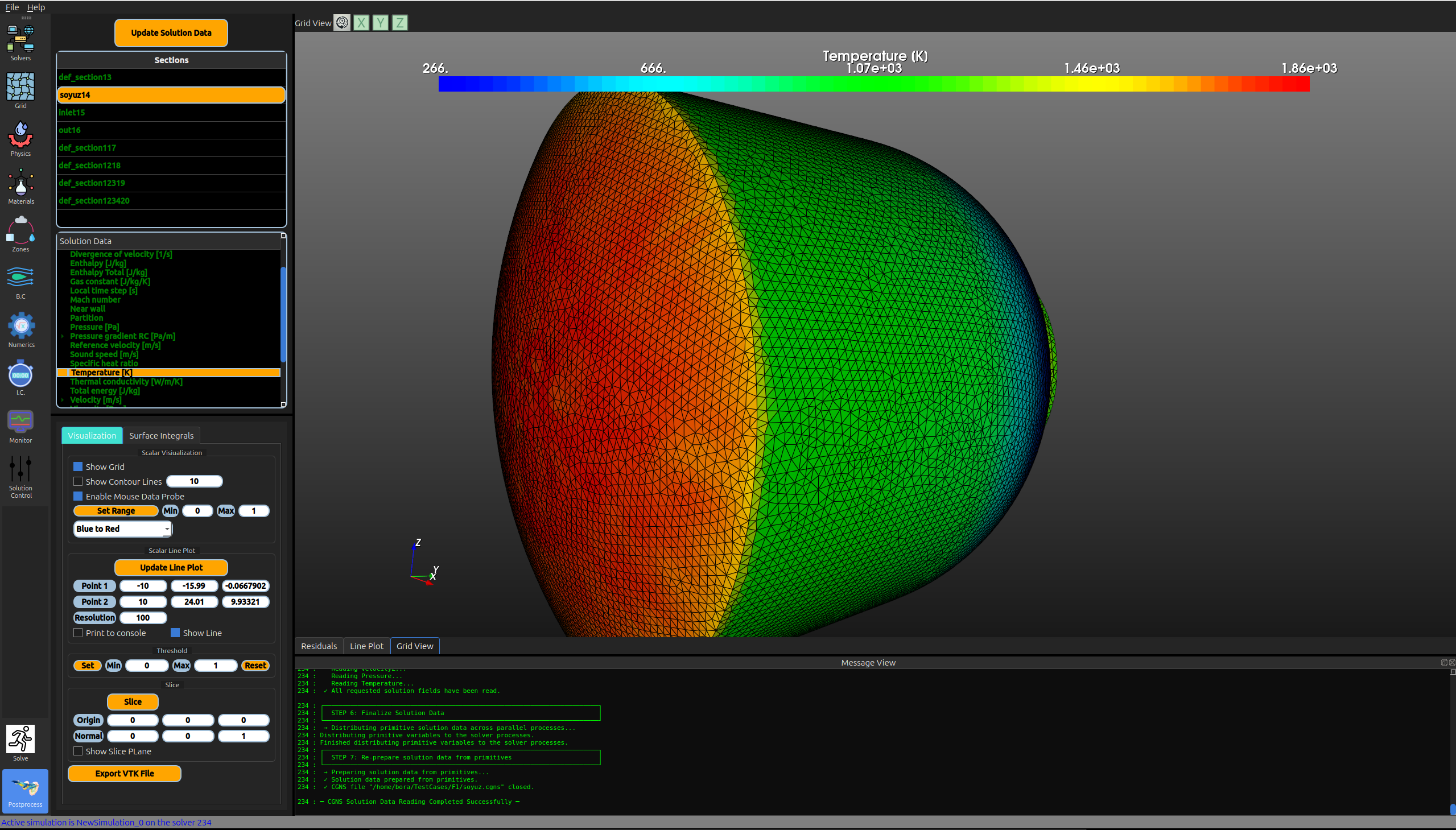
Its y⁺-independent wall treatment supports turbulent heat transfer, conjugate heat transfer and advanced thermal-wall models over changing near-wall resolution.
Eulerian dispersed phase
The Eulerian particle solver is integrated within the strongly coupled framework for metallized propulsion products, dust-laden flows, granular systems and thermally interacting dispersed phases.
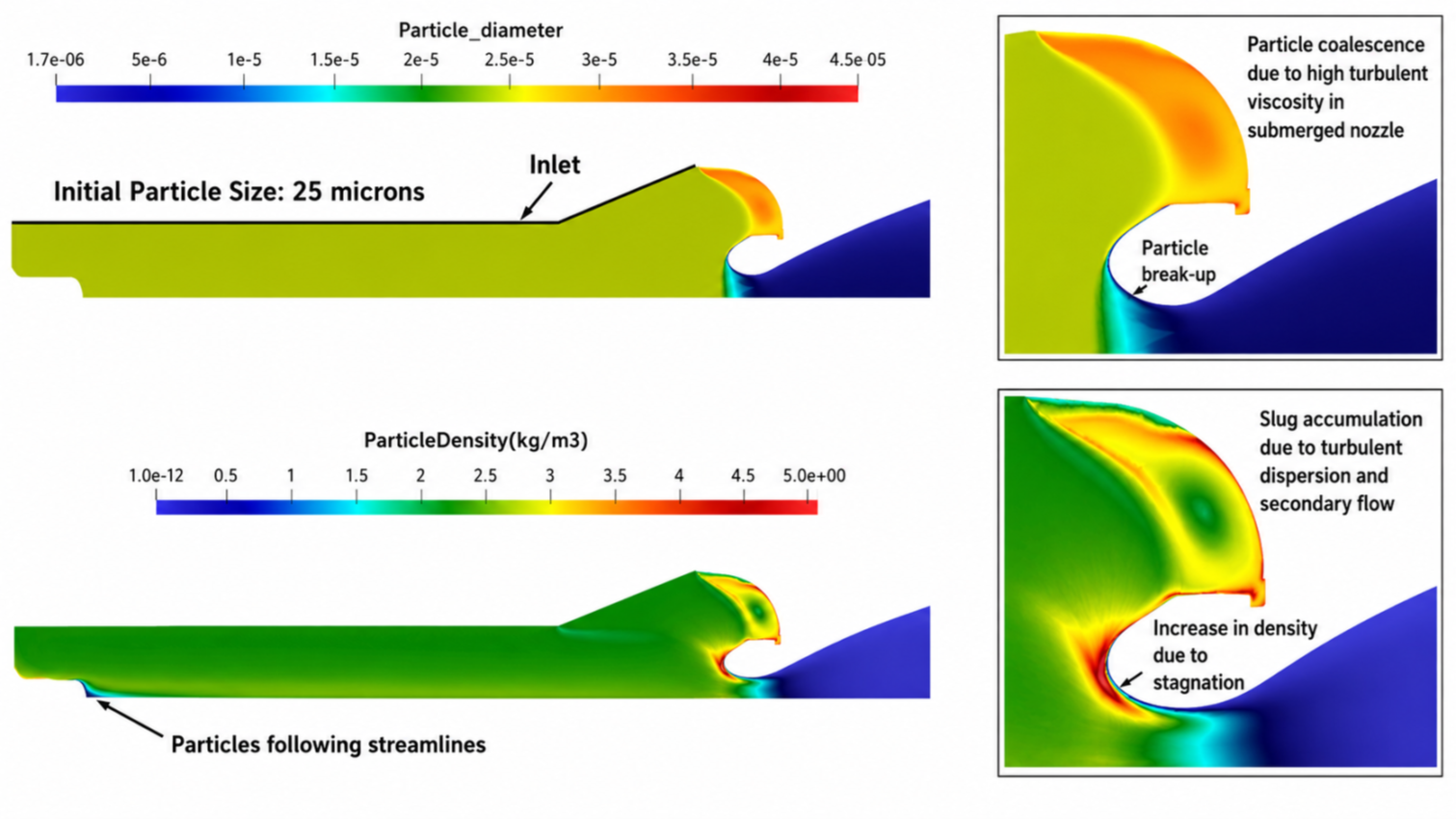
The transported interfacial-area field links local dispersed-phase morphology to gas-particle momentum and heat exchange. The solution resolves changing effective particle scale instead of assuming a fixed uniform diameter.
It shows breakup near the lip, coalescence in the turbulent recirculation region and accumulation driven by stagnation and secondary flow.
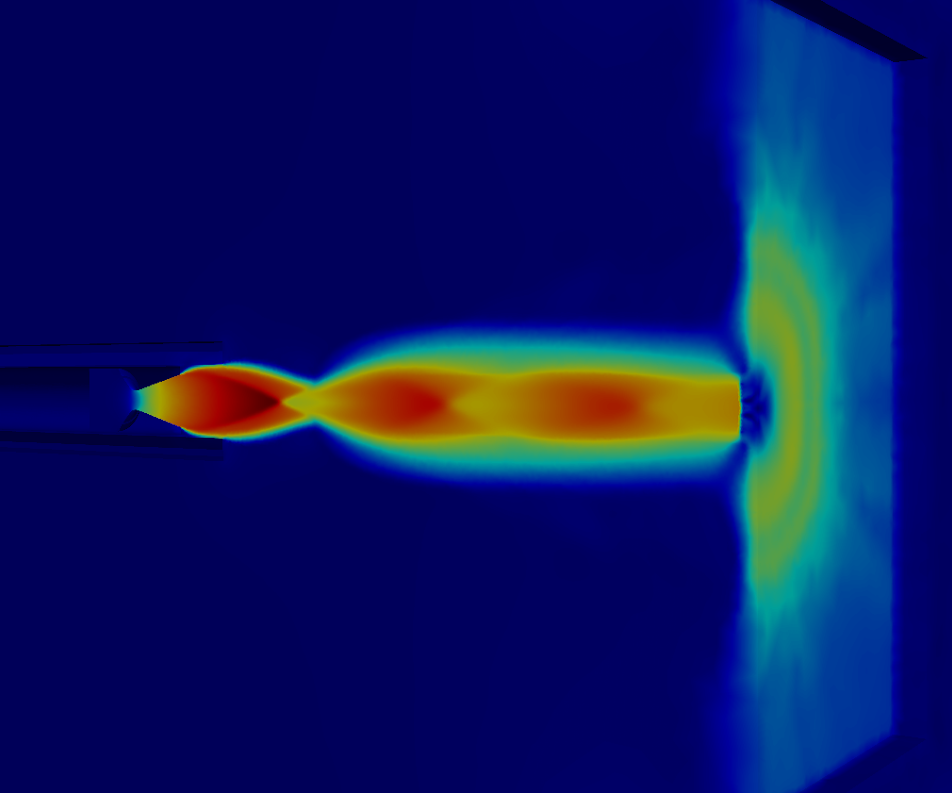
The dispersed phase is transported with the surrounding compressible gas, including momentum and thermal exchange. The launch-plume result demonstrates the coupled response under a strongly expanding, high-temperature flow.
Linear and nonlinear solver technology
The implicit formulation produces large sparse systems containing the interaction of flow and additional physics. NeuralFlow combines GPU-capable sparse linear algebra, Krylov methods, algebraic multigrid and geometric multigrid technologies to make these systems practical on engineering meshes.
Extensibility and engineering workflow
NeuralFlow is not limited to fixed built-in models. Its architecture supports case-specific development, external workflow integration and user-defined extensions.
Advanced numerical capabilities
NeuralFlow combines specialized transport formulations, convergence acceleration and scalable linear algebra for problems that are difficult to solve reliably with conventional workflows.
Application areas
NeuralFlow is especially valuable where aerodynamic performance, thermal loading, transient response and additional physics must be assessed together. Propulsion systems are shown with representative cases; broader flow and thermal domains are summarized below.
Propulsion systems
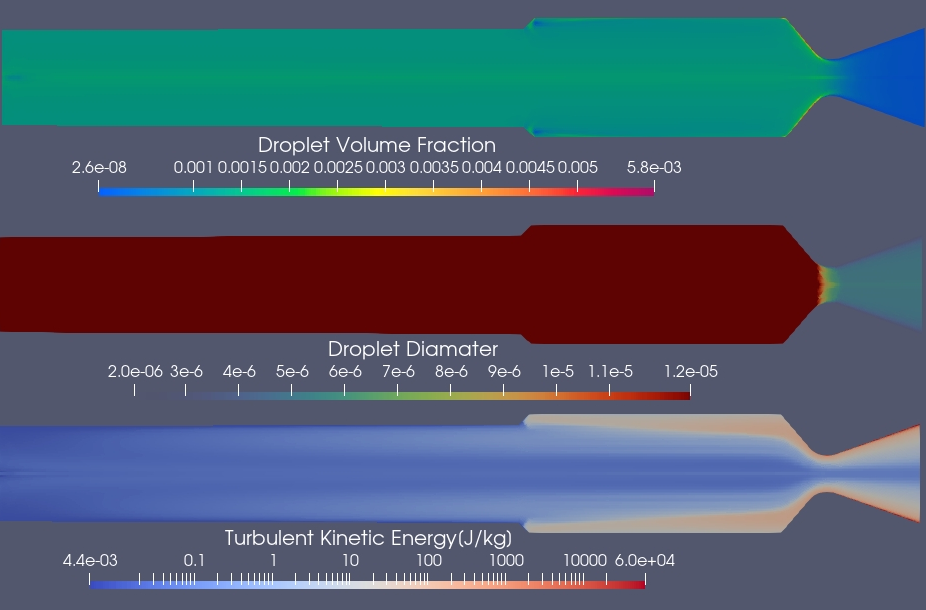
Internal ballistics, combustion chambers, nozzles, pressure oscillations, particles and thermal loads.
Representative case: rocket-nozzle internal expansion, plume structure and surrounding-flow interaction.
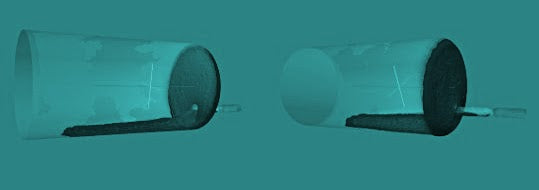
Supersonic intakes, combustors, fuel-rich gas generators, boron particles and aero-propulsive integration.
Representative case: boron-particle transport in a ducted-rocket fuel-gas-generator application.
Additional application domains
Shock systems, separation, drag, aerothermal heating and high-Mach operating envelopes.
Internal expansion, jet structure, launch interaction and condensed-phase exhaust products.
Conjugate heat transfer, charring materials, hot walls and cooling-flow design.
Multiple Reference Frames, turbomachinery, fans and coupled process-flow systems.
Dispersed solid phases in propulsion and process flows, including particle inertia, gas-particle momentum and heat exchange, loading effects and interfacial-area evolution.
Injected droplets and sprays in combustors, ducts and cooling flows, including transport, gas-droplet momentum and heat exchange, breakup and coalescence.
GUIX-H integration
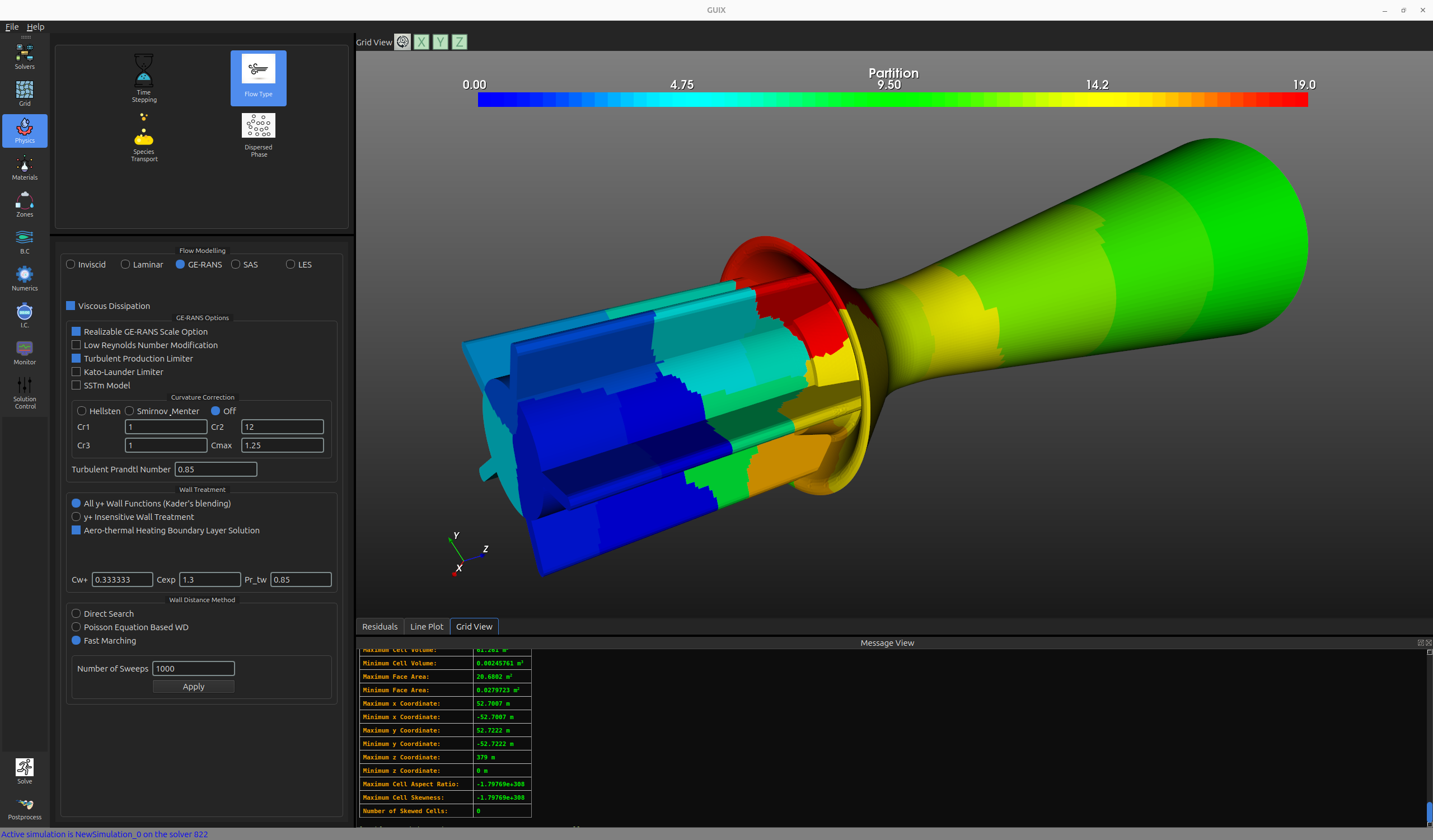
GUIX-H connects case definition, solver controls, execution, convergence monitoring and post-processing in one engineering workflow. Its direct communication with NeuralFlow supports interactive simulation control and real-time access to solver and result data.
Explore GUIX-HRelated LIKUA capabilities
NeuralFlow works within a broader software and engineering environment covering user interaction, learned solver technology, hydrodynamics and scalable computing.
Development status
Production capabilities are presented separately from models still undergoing implementation, verification or extended validation.
Technical contact
Share the geometry, operating conditions, physical models and engineering decision you need to support. LIKUA will define a technically defensible NeuralFlow workflow and the evidence required to trust the result.
Contact